From smart appliances to humanoids: What IFA 2026 tells us about the robotic kitchen
Tue 8th Sep 2026 by Emma Hedges
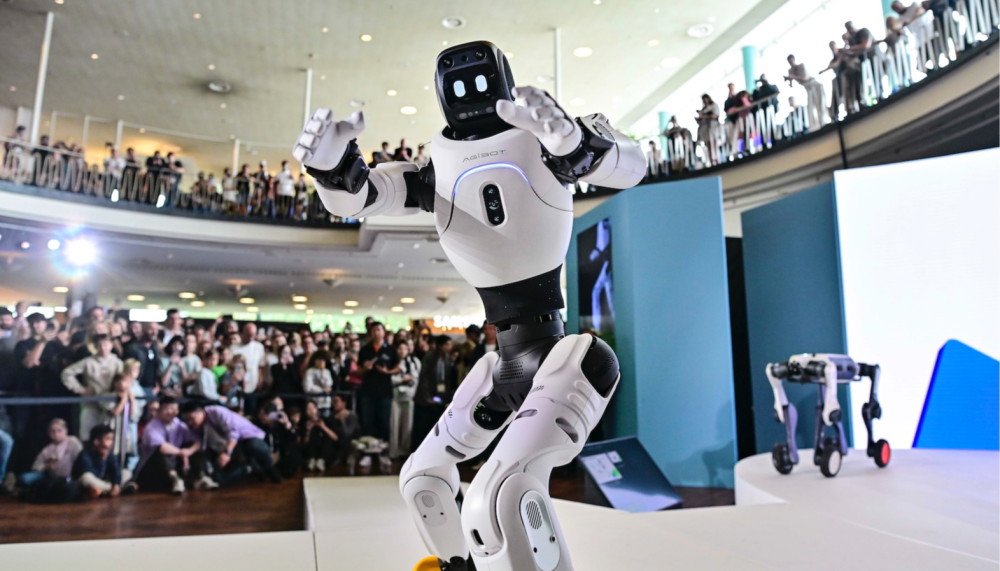
From smart appliances to humanoids: What IFA 2026 tells us about the robotic kitchen

An expert panel discussion at IFA 2026 highlighted how AI and robotics are turning the kitchen from a collection of appliances into an intelligent, autonomous ecosystem. But how will this impact kitchen design? Will retailers be factoring robot garages into layouts anytime soon?
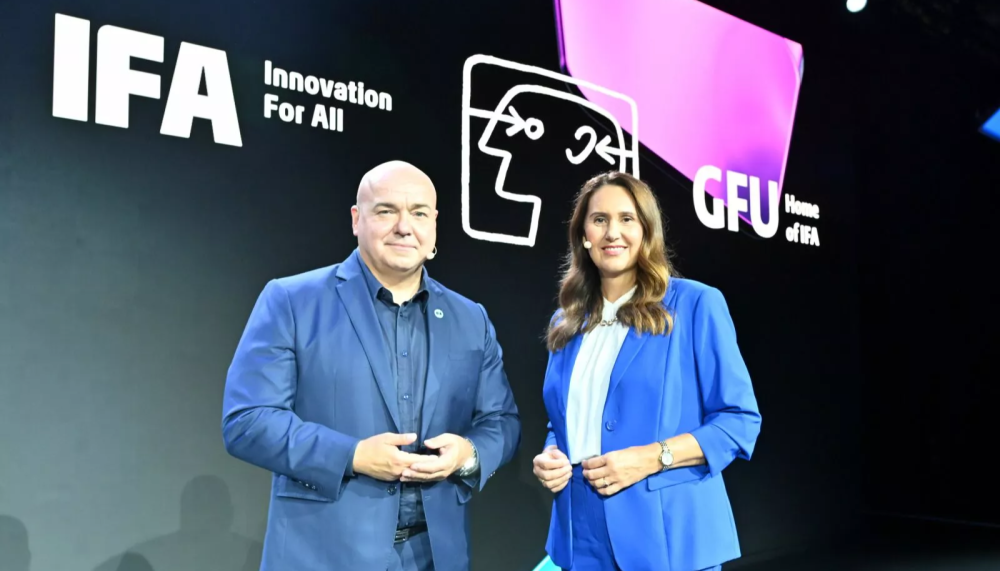
The prospect of a robot cooking dinner, loading the dishwasher and tidying the kitchen has moved another step closer to reality – but experts taking part in a panel discussion at IFA 2026 were divided about how likely it is that humanoids will become part of the truly robotic home. The panellists were Jennifer Pattison Tuohy (senior reviewer, smart home, The Verge), Raghav Gupta (co-founder and CEO, Posha), Michael Wolf (editor and founder, The Spoon), Dr Glenn Mathijssen (MD, Alberts Products, Circus Group) and Jiyuan Zou, CMO of PrimeBot Robots. Jiyuan Zou even brought Keith – a small humanoid robot – onto the stage, offering the audience a first-hand glimpse of the technology’s future.
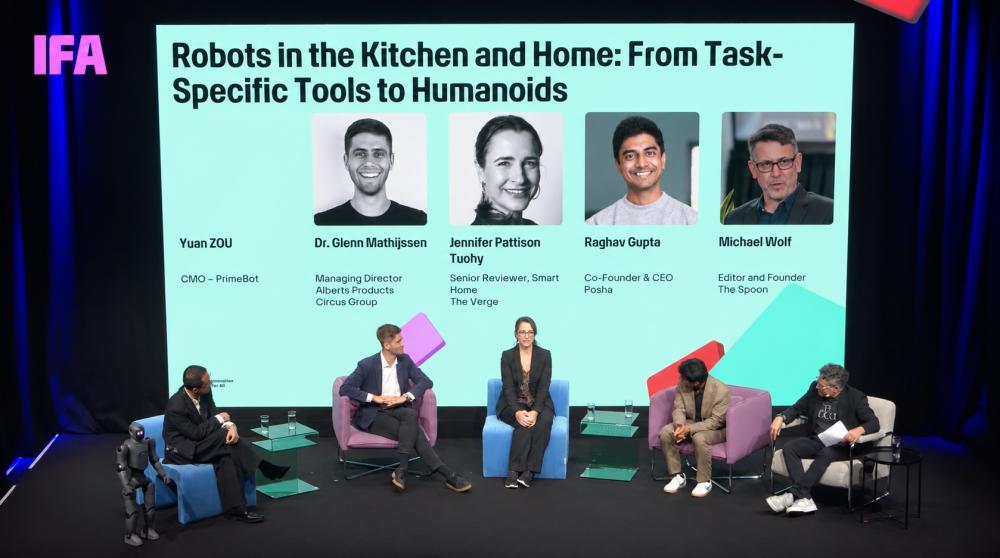
The case for task-specific robotics
One of the clearest distinctions that emerged from the discussion was the difference between robots designed to perform a specific task and the much broader ambition of a humanoid robot capable of operating throughout the home.
Raghav Gupta, co-founder and CEO of cooking robotics company Posha, represents the former approach. Posha is designed specifically to automate elements of cooking, taking on more of a 'sous chef' role to support the user rather than attempting to take over as a human chef or household assistant. Its approach is significant because it demonstrates that useful domestic robotics does not necessarily require a machine to walk around the home.
Instead, the technology can be built around a particular environment and a particular task – in Posha's case, preparing food. That makes the technical challenge considerably more manageable and raises an important question: does a robot really need to be humanoid to be useful?
The kitchen is a particularly difficult environment
Cooking presents an unusually complicated challenge for automation. Unlike a factory, where robots operate in highly controlled and predictable environments, a domestic kitchen is constantly changing. Ingredients vary, people move around, objects are left in different places and cooking itself is an inherently variable process. This is where the distinction between AI that understands a task and a machine that can physically navigate the entire home – including stairs – becomes important.
A dedicated cooking robot can be designed around known parameters. A general-purpose humanoid, by contrast, has to understand an environment it has never seen before, identify objects, move safely around people and respond to unexpected situations. In order to do that, it pretty much has to be 'trained' by the user.
Rather than waiting for a fully autonomous robot chef, there is a much more immediate opportunity for manufacturers to embed increasingly sophisticated robotics and AI into individual appliances. The result could be a kitchen containing several specialised automated systems rather than one robot that does everything.
From appliances to robotic ecosystems
This points towards perhaps the most important implication for the KBB sector: the future smart kitchen may become an ecosystem of intelligent machines. Instead of one humanoid carrying out every task, consumers could have a cooking appliance that helps prepare food, an oven that understands what is being cooked, and a dishwasher that determines the most appropriate cycle.
The intelligence increasingly sits behind the appliance rather than simply in the appliance's controls. For kitchen designers and retailers, that creates a new conversation with consumers: not simply 'what appliances do you want in your kitchen?', but instead, 'what would you like your kitchen to do for you?'
Humanoids offer something different
Nevertheless, a human-shaped robot has an obvious advantage in a home designed around human beings: it can potentially use the same worktops, cupboards, appliances, doors and utensils as its owner. It does not require an entirely new kitchen infrastructure to operate. And unlike a task-specific appliance, a humanoid could theoretically move between tasks. One moment it might be helping with food preparation; the next it could retrieve something, assist with household chores or provide support elsewhere in the home.
That is the longer-term proposition being developed by companies exhibiting humanoid robots at IFA this year, with companies including PrimeBot Robots, EngineAI, Cozio Robotics, Dobot, DEEP Robotics, Agibot, Unitree and others demonstrating different approaches to physical AI.
But what does a robot actually need to do to earn a place in someone's home?
Robots and earning trust in the home
The kitchen is an intimate environment. It is where people prepare food for their families, where children play and do homework, and where potentially dangerous equipment, heat, water and sharp objects are all being used. The panel identified trust, safety and acceptance as central issues in the discussion.
A consumer may be happy for a robot vacuum to move around the house autonomously, but allowing a machine to manipulate food, operate a hob or move around a kitchen while people are present represents a considerably higher level of trust. That means the successful domestic robot will have to be more than technically capable. Consumers will need to understand what it is doing, feel confident that it will behave predictably and believe that it adds genuine value.
PrimeBot's Jiyuan Zou framed this idea in terms of the robot becoming part of everyday family life. His vision extends beyond robots simply performing individual tasks: they should increasingly understand a family's environment, habits and preferences.
An important role in ageing in place
Another strand of the discussion with particular relevance to kitchen design was ageing in place. Domestic robotics have huge potential to help people maintain independence for longer by assisting with daily food preparation, monitoring and household tasks, while retaining dignity. Robotics could increasingly be positioned as an accessibility tool.
For an older homeowner, a system that can monitor cooking, assist with food preparation or take over physically demanding household tasks could make the difference between continuing to live independently and requiring outside assistance. For kitchen designers, this potentially makes automation part of the wider conversation around future-proofing a kitchen.
What does the kitchen of 2030 actually need?
The IFA discussion concluded by pointing to a more nuanced future than the familiar image of a humanoid robot standing at the cooker. There will almost certainly be humanoids, and the rapid progress in this area demonstrated at IFA 2026 makes it increasingly difficult to dismiss them as science fiction. But the most useful domestic robots may initially be much less glamorous.
They could be built into appliances, positioned on worktops or designed to perform one task exceptionally well. And that may actually be good news for the kitchen industry. Robotics could ultimately make the kitchen more responsive, more automated and more personalised, while allowing designers to retain the human-centred spaces that consumers value.
Main image: Humanoid robots on the runway at IFA 2026
Tags: kitchens, features, ifa 2026, robotics, humanoids, smart home, appliances, connected home







Sign up to our newsletter
Most Read