Digital marketing – How Google's AI overviews are signalling the end of SEO
Mon 27th Apr 2026 by Katrina Bell
Digital marketing – How Google's AI overviews are signalling the end of SEO

Google's new AI overview strategy makes it harder to draw visitors to your website, which signals the end of SEO as we know it – Katrina Bell explains what's coming next.
Since its inception in 1998, Google made sense of the worldwide web better than any other search engine or app. It became the map for the entire Internet, and SEO – or search engine optimisation – was the indexing tool.
However, everything you know about website and social marketing SEO is changing, and the starting point is Google’s own home screen.
As soon as it began adding AI overviews, the search engine giant made its intentions clear – Google expressly wants you to stay on the landing page where it can sell ad space. Or the information is behind a paywall – if you don’t buy ads from them, does your Google Business Profile still have a phone number on it? Soon it may not.
Research by the Pew Research Center in 2025 found that Google AI views significantly reduce user clicks to sites. The study found only 8% of users who see the AI summary end up clicking a ‘traditional search result.’ That’s your website address and the short summary you have added to your front page elbowed even further down the results, even if it is the most relevant answer.
The percentage of Google searches with an AI summary varies depending on the source and time of the enquiry – it can range from 18% to over 50%. Pew found AI summaries appeared in one in 5 of all searches. More dramatically, a June 2025 study by Xponent21 reported AI overviews showed up in over 50% of all search results.
From a Google standpoint, it’s happy to gobble your content, but isn’t interested in sending queries directly to you. It now even considers your social media content a more critical ranking model for your SEO.
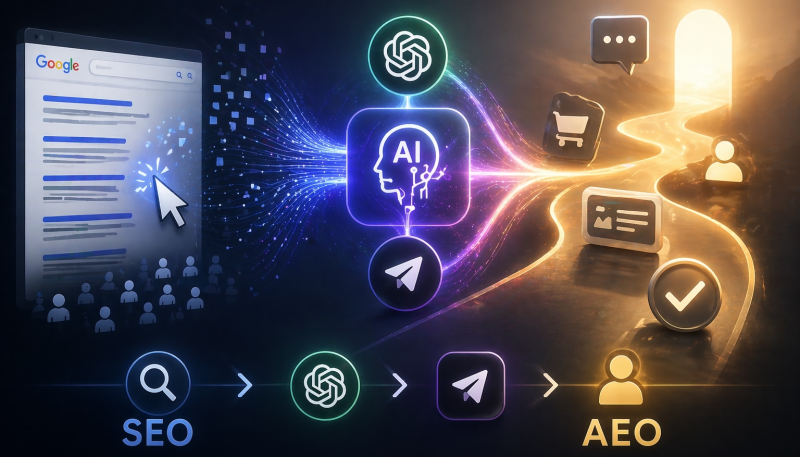
And while that is going on, the AI models are stealing Google’s shine by launching their own browsers with search baked into the architecture. This makes absolute sense for the Millennials, who find the chatty format of apps much more appealing.
ChatGPT’s Atlas desktop app, currently available for MacOS, is part results engine, part concierge and shopping assistant, which makes absolute sense given that Shopify is in the process of being latched permanently into ChatGPT. The tagline of Atlas is ‘Unlock the Web’, as if Google had never done it in the first place. Perhaps because Google broke itself on the yoke of profits.
So what’s next? It’s called AEO or Answer Engine Optimisation and you are already doing it.
In the coming months this term is going to take over the narrative in digital marketing but at its core it is about writing content that directly answers questions and translates easily to your socials. You will need to write content for what people are searching for. And that will inevitably bleed into how we all use websites. Not just how we find them. It’s not just a technology shift – it’s a distribution shift. But what replaces the old-school behaviour of ask and find?
Watch this space.
Tags: insight, features, digital marketing, social media marketing, seo, aeo, google, kitchens, bathrooms





Sign up to our newsletter
Most Read